It’s time to submit your ideas for Buggy Enhancement Grants for the fall semester! Through the generosity of the various members of the Buggy Alumni Association we have secured funds for the Buggy Enhancement Grants! This money belongs to you as a member of the buggy community to enhance the sport. If you have ideas that you think will enhance the buggy experience, we want to hear from you!
Submissions are due by October 9th and will be reviewed by the Buggy Endowed Fund Committee the following week. Applicants will have one week to respond to committee feedback before the final vote. Approved grants will then be announced October 23rd.
Proposals can be specific to your team, please include some details on how the community as a whole will benefit from funding your project. For example, you might share documentation of your process, publish a video, or give a talk about your findings. You might build something to collect better data during rolls, test out a new material, or build something to make chores easier.
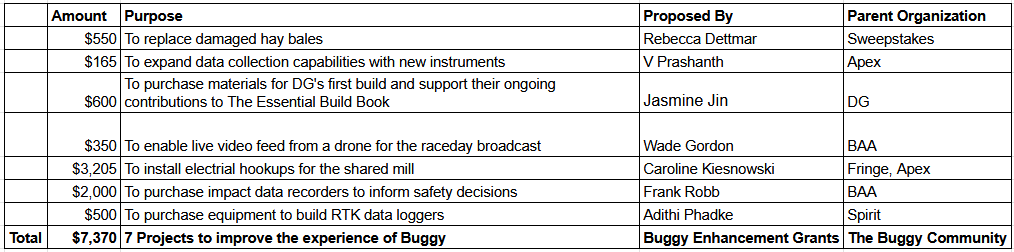
For Raceday 2026 Buggy Enhancement Grants, we approved $7,370 to fund 7 projects from 7 different organizations.
For more information on the grant program, including previously approved grant applications, materials and findings from previously approved grants, how to spend your grant money, and more, please read All About Buggy Enhancement Grants.
To better serve the Buggy community, we will be keeping the Buggy Enhancement Grant application open all semester. Half of the remaining unallocated funds from the grant pool will be available on a first-come-first-served basis.
After you submit your application, expect an email from the committee the following week with questions and concerns that they would like to see addressed. Once you have responded to the committee’s feedback, we’ll hold the final vote on your grant proposal.
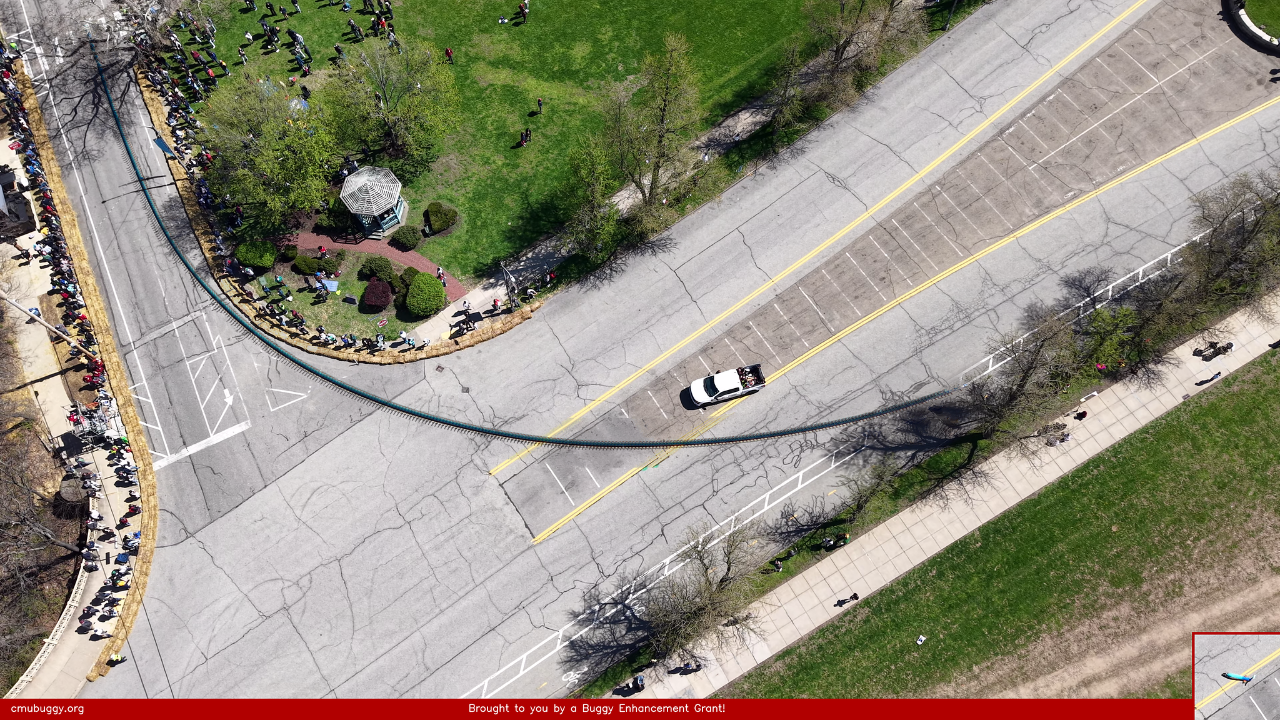
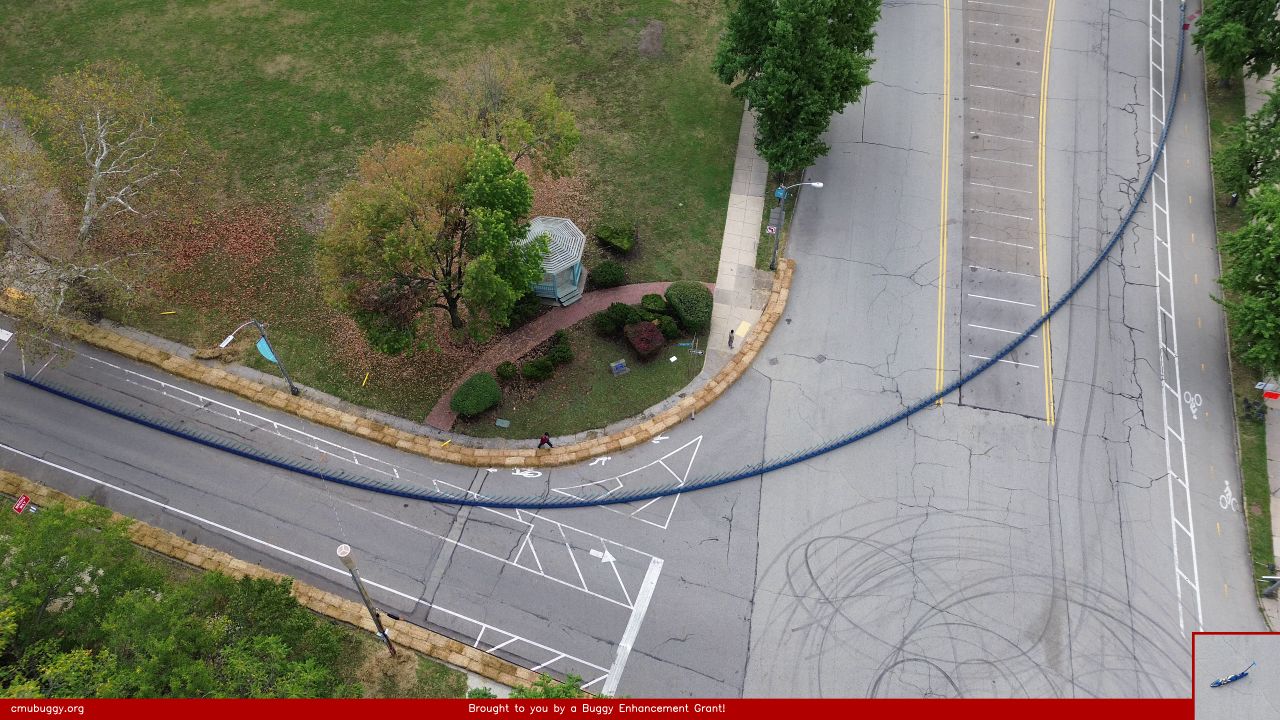
We have an exciting update on the Buggy Enhancement Grant drone project. This week was our first test of automatically generating composite images of the driver’s line for every buggy for a full day of rolls. This system enables quick turnaround for driver’s to analyze their line and make incremental improvements as they work up to raceday speed. The original drone footage gives an incomparable view of the speed and handling of the buggy as the driver navigates through the chute, and the composite images highlight minute differences in the geometry of the turn.
This is a multidisciplinary multi-organization project led by Tjaden “TJ” Bridges of SDC, and received funding as part of the spring 2024 Buggy Enhancement Grant campaign. It truly captures the spirit of the Buggy Enhancement Grant program by making the sport faster, safer, and more enjoyable for everyone.
The footage and images are tools for you to make your team safer and faster. They are not a substitute for caution and good judgement in how the drivers, mechanics, and pushers plan how to safely get the team up to speed.
Behind the Scenes
On the Ground
The biggest challenge for this project came from the logistics of getting permission from everyone to have the drone in the air during their rolls and ensuring all of the equipment is prepped and ready for every day of rolls.
In the Air
Wind conditions permitting, we record from 50 meters above the northwest corner of Schenley Drive and Frew Street with the camera is tilted down at 55 degrees. We try to keep a few meters leading up to the chute flag in view so drivers have good feedback on the timing of when they should start the turn.
On the Web
The image compositing is done with an OpenCV Python script. A background subtractor generates an on the fly model of the road and highlights differences between frames. A blob detector then identifies candidate moving objects in each frame, and a set of Kalman filters track the trajectories between frames. This allows us to filter out small motion and slow moving objects, but the occasional goose in flight still gets its own line photo. The relevant frames are all aligned to the first frame for each buggy, and the tracking data gives us a mask to efficiently apply a bit of math to the pixel values that selectively lightens or darkens the composite image. Labeling the images with the org/buggy is still a manual process, but we’re working on training an image classifier to auto tag the images.
I am overjoyed to announce that 100% of the grant applications we received for the Fall 2025 grant campaign have been funded! Thank you to all of our applicants for taking time to assemble such strong applications!
Caroline Kiesnowski received funding to install an electrical hookup for the shared mill that resides between the Fringe and Apex shops.
Adithi Phadke received funding to build RTK data loggers for SPIRIT Racing Systems.
Frank Robb received funding to purchase FIA impact data recorders for potentially the entire fleet of rolling buggies. The grant funds hardware for any rolling buggy, so please reach out if you are interested in collecting this data for your team.
Wade Gordon received funding to purchase software and equipment to facilitate getting real time footage from a drone to the broadcast truck.
It is time to submit your ideas for Buggy Enhancement Grants for the fall semester! We have over $12,000 available for this round of funding. This money belongs to you as a member of the buggy community to enhance your enjoyment of the sport! If you have ideas that you think will enhance your buggy experience, we want to hear from you!
Submissions are due by September 15, and will be reviewed by the Buggy Endowed Fund Committee the following week. Applicants will have 1 week to respond to committee feedback before the final vote. Approved grants will then be announced October 1st.
Proposals can be specific to your team. Please include some details on how the community as a whole will benefit from funding your project. For example, you might share documentation of your process, publish a video, or give a talk about your findings. You might build something to collect better data during rolls, test out a new material, or build something to make chores easier.
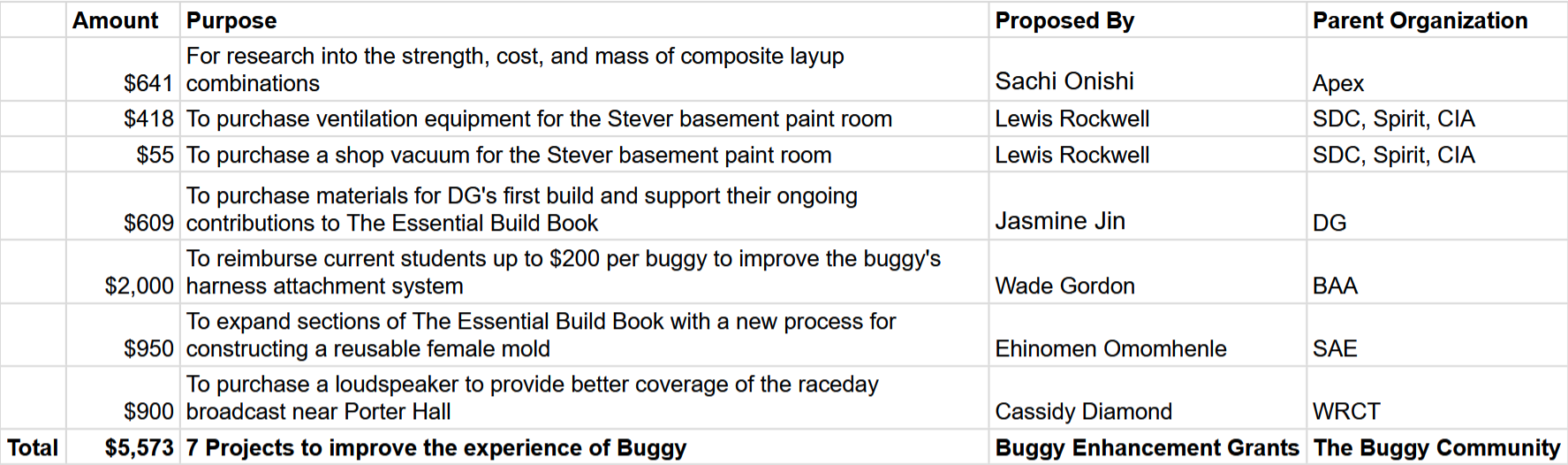
For RD 2025 Buggy Enhancement Grants, we approved $5,573 to fund 7 projects from 8 different organizations.
For more information on the grant program, including previously approved grant applications, materials and findings from previously approved grants, how to spend your grant money, and more, please read All About Buggy Enhancement Grants.
The application deadline for the Buggy Enhancement Grants is TOMORROW, January 23 at midnight! If you have an idea for something that would enhance your enjoyment of the sport, this is your chance to receive funding and bring that vision to life!
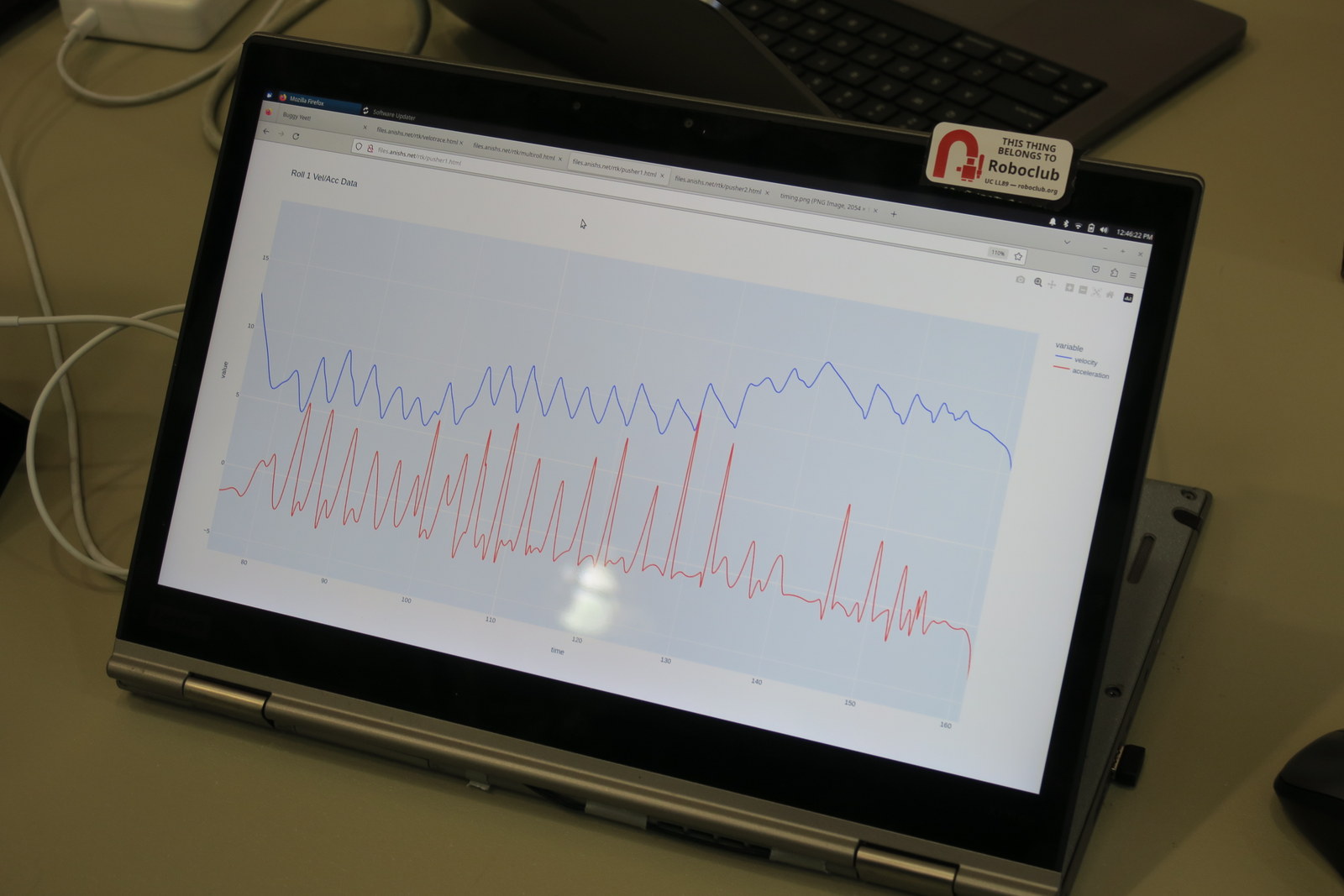
Real Time Kinematic GPS has been a popular topic in Buggy Enhancement Grant proposals. As more teams are expressing interest in building out their own data loggers, I wanted to share some info on two proven systems that will allow you to get centimeter level accurate data from the buggy course.
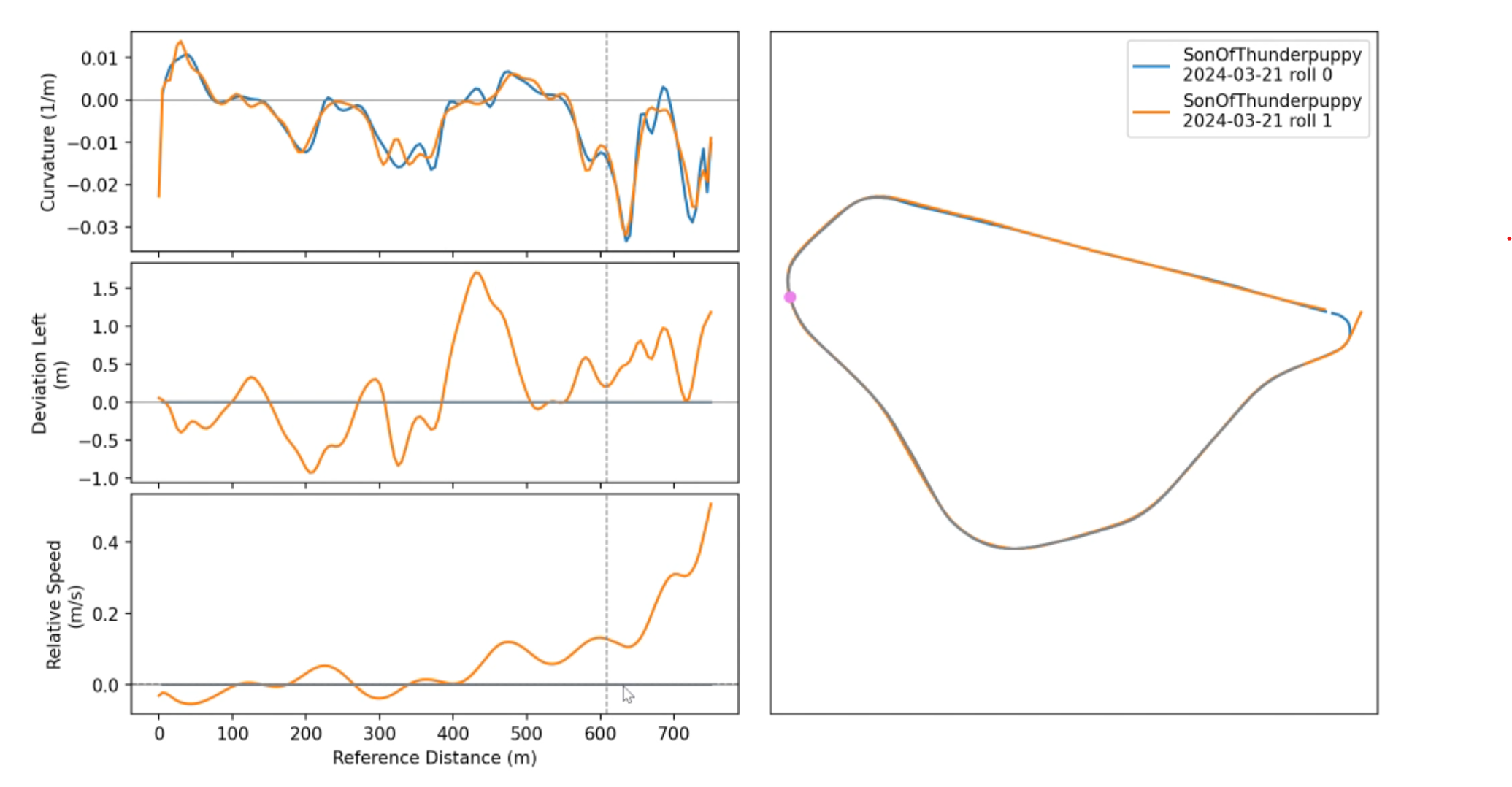
This quality of data opens a lot of opportunities, and I’m sure we’ve still only seen the tip of the iceberg. Drivers can clearly see the differences in their line between rolls and quantitatively compare the rollouts. Mechanics can see where and how much energy is lost in different parts of the course to fine tune the steering configurations and tire treatments. Pushers can automatically collect split times and even drill down into technique and how much power was delivered during a transition shove.
If this has you feeling inspired, I hope you’ll consider applying for a Spring 2025 Buggy Enhancement Grant. Applications are due by midnight on Thursday, January 23rd.
Arduino Based System
This system was developed by the CMU Robotics Club. Detailed documentation can be found in the project GitHub: https://github.com/CMU-Robotics-Club/rtk-datalogger Note that some soldering will be required. For specifics on where to purchase components and other tips and tricks for getting started with RTK, please refer to the Onboarding Doc.
I would have liked to recommend purchasing a ZED-F9R for the built in accelerometer and ability to integrate wheel rotation and steering input sensors, but that might require changes to the PCB design and updates to the firmware.
Part
Cost
Seed Studio RP2040
$4
SparkFun ZED-F9P
$250
GNSS Antenna
$73
USB Breakout Board
$5
SD Card Reader
$4
OLED Board
$14
USB-C Battery Pack
$20
SD Card
$12
PCB
See GitHub
Total
$382
Raspberry Pi Based System
This system does not require any soldering. We’re working on building out a set of scripts to automate the setup, post processing, and gathering logs from a fleet of devices over WiFi. Keep an eye on the project GitHub and reach out if you are interested in the beta. For specifics on where to purchase components and other tips and tricks for getting started with RTK, please refer to the Onboarding Doc.
Part
Cost
Raspberry Pi Zero W 2
$18
ZED-F9R Dead Reckoning Pi Hat
$290
GNSS Antenna
$73
USB-C Battery Pack
$20
SD Card
$12
Total
$413
Special Thanks
I want to thank Anish Singhani and Delaynie McMillan as the original authors of the Buggy Enhancement Grants that made this possible and for the incredible amount of work that RoboBuggy and Radio Club put into establishing and maintaining the RTK base station on campus.
Thank you to all of our Golden Goose Lifetime Members who have donated to the Buggy Endowed Fund and made Buggy Enhancement Grants possible.
Thank you, Robbie, and Lewis, for helping me put together all the pieces for this BoM.
Thank you to everyone who has already submitted their Spring 2025 Buggy Enhancement Grant applications! If you haven’t submitted yours yet, applications are due by midnight on Thursday, January 23rd.
It is time to submit your ideas for Buggy Enhancement Grants for the spring semester! We have over $12,000 available for this round of funding. This money belongs to you as a member of the buggy community, to enhance your enjoyment of the sport! If you have ideas that you think will make buggy better, we want to hear from you, please apply here!
Submissions are due by midnight on Thursday, January 23rd. The committee will complete its initial review on Friday, January 24th, and applicants will have 1 week to respond to the committee’s feedback before the final vote.
Last semester we saw $3723 allocated towards composites testing, expanding the Essential Build Book (while building DG’s first buggy!), improving shop safety, and improving the safety of existing buggies.
For more details on the program, a summary of previously approved grants, and tips from the committee on how to write a stellar grant application, please read All About Buggy Enhancement Grants.
If you would like to support this program, please consider donating to the Buggy Endowed Fund. Your gift will help perpetually fund this grant program and keep the buggy hype rolling for generations to come! A donation of at least $1000 to the endowment is recognized on our placard in the University Center and with a lifetime membership to the Buggy Alumni Association. There is no shortage of excellent project proposals coming from the community, so please consider supporting this program. Join us Now!
The Buggy Enhancement Grant Committee, and the BAA have two new options for teams that would like additional financial support.
If your team has not rolled a new buggy in the past 4 years, the BAA will reimburse up to $500 of build related expenses. This applies to new and ongoing builds. Reach out to Diya Nuxoll <diyanuxoll@cmubuggy.org> if you are interested in taking advantage of this funding!
Existing buggies have been granted up to $200 for improvements to the harness attachment system. This Buggy Enhancment Grant includes funds for 10 buggies, with the option for some discretionary funding for tools and bulk purchases. Reach out to Wade Gordon <wadegordon@cmubuggy.org> if you are interested taking advantage of this funding.
Even if neither of these apply to your team, reach out to the BAA Teams Committee if you would like help finding sustainable sources of funding for your team, need advice to support your build, or need to find an extra set of hands for a critical work session.
There are 6 days left to apply for a Buggy Enhancement Grant for Fall 2024! There is $12,000 available in this semester’s funding pool. This money belongs to you as a member of the buggy community to help make the most of your buggy experience! Applications are open until Sunday night. Don’t wait, get your application in today!
If you are looking for inspiration, for your grant proposal, you can view previously approved grant applications here. For your one stop shop to learn everything there is to know about Buggy Enhancement Grants including tips from the committee on how to strengthen your grant proposal, please read All About Buggy Enhancement Grants! If you have any questions or would like early feedback on your proposal, please feel free to reach out to any BAA or Sweepstakes officer on Discord.
Thank you to everyone who already submitted their application!